
Anxiety and Depression-
HYPNOTHERAPY FOR ANXIETY
Hypnotherapy is now considered by most to be a very effective way to alleviate these horrible conditions. There are now many scientific journals that prove hypnosis is a perfect therapy for anxiety or depression. Often referred as ‘Generalized anxiety disorder’ (GAD). One of the main reasons there have been more scientific papers looking at anxiety and hypnotherapy, is because anxiety has been drastically on the increase since 2010. This accelerated even more in March 2020…for obvious reasons! Anxiety UK
The main reason for the radical increase in anxiety since 2008 (according to the excellent recent Netflix documentary ‘Social Dilemma’), is social media. thesocialdilemma .Hypnotherapy for anxiety is needed now more than ever. WHO
The desire for a ‘hit’ of dopamine, coupled with a failure to gain instant gratification, may prompt users to perpetually refresh their social media feeds.
Two very different conditions, but often go together. Hypnotherapy goes to the root of these issues. This is why hypnosis for depression, or hypnotherapy for anxiety is so powerful and effective.
Most clients need only 2-4 sessions, to resolve these problems. When you compare this to traditional talking therapies, the results speak for themselves.
_______________________________________________________________
Anxious Thoughts
Are your having anxious thoughts that won’t seem to go away? Do you struggle with fear, panic and worry? Are you losing sleep? Has COVID-19 unsettled you?
If the answer is yes, you aren’t alone. Many people in Dartford, Bexley, Sidcup, & Gravesend Kent have these issues and want to find a pathway to change. This is particularly true if anxiety has interfered with your relationships or has diminished the quality of life
Scientific research suggests that there exists a unique relationship between the Amygdala (a small, almond shape area of the brain) and the fear response. Specifically, the Amygdala is thought to be a causal factor in the traditional “flight or fight” response, which a universal characteristic of animals, including humans.
___________________________________________________________________________________________________
The Amygdala
The Amygdala in your brain is always “watching” – there in the background – and has taught itself to respond psychologically and emotionally to anything it perceives as a threat.
But sometimes the Amygdala creates “false positives”, triggering a flight or fight response that is irrational. An example might be having an extreme fear of flying.
Hypnosis can help to retrain this part of your brain to have a different reaction to fear inducing causes. This doesn’t happen instantly and should be part of a comprehensive approach to wellness, such as psychotherapy.
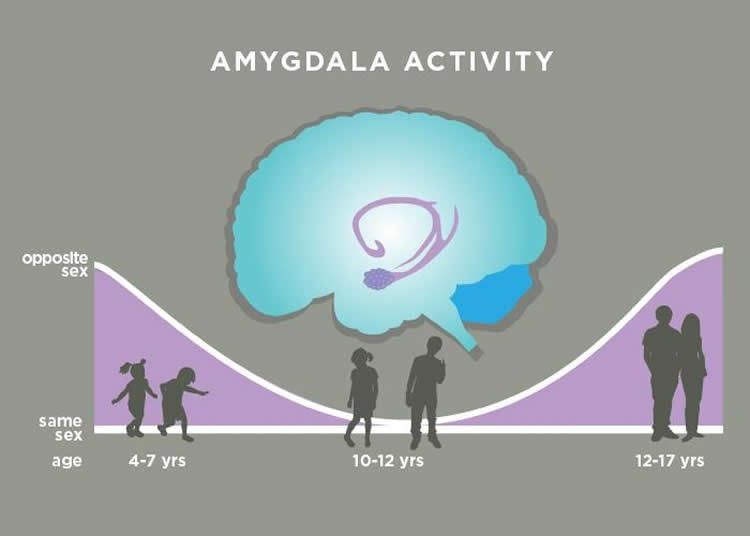
Scientists have found a signal in the brain that reflects young children’s aversion to members of the opposite sex (the “cooties” effect) and also their growing interest in opposite-sex peers as they enter puberty. These two responses to members of the opposite sex are encoded in the amygdala, the researchers report.
The findings, reported in the Journal of Cognitive Neuroscience, challenge traditional notions about the role of the amygdala, the researchers say.
The team evaluated 93 children’s attitudes toward same-sex and opposite-sex peers. Using functional MRI, which tracks how oxygenated blood flows in the brain, the researchers also analyzed brain activity in 52 children.
The amygdala was once thought of as a “threat detector,” said University of Illinois psychology and Beckman Institute professor Eva Telzer, who led the new analysis. “But increasing evidence indicates that it is activated whenever someone detects something meaningful in the environment,” she said. “It is a significance detector.”
The finding that very young children are paying close attention to gender is not a surprise, Telzer said.
“We know that there are developmental changes in terms of the significance of gender boundaries in young kids,” Telzer said. “We also know about the whole ‘cooties’ phenomenon,” where young children develop an aversion to opposite-sex peers and act as if members of the opposite sex could, if they got too close, contaminate them with a dreadful infestation. Children at this age also tend to strongly prefer the company of their same-sex peers, she said.
This phenomenon was reflected in young children’s evaluations of each other.
“Only the youngest children in our sample demonstrated a behavioral sex bias such that they rated same-sex peers as having more positive (and less negative) attributes than opposite-sex peers,” the researchers wrote.